ETC-C and ACI 349 compared on a nuclear island building
A study presented at TINCE’26 designed the same slab and shear wall from Hinkley Point C to the French and US nuclear codes, with Shell Element Designer producing the ACI 349 designs. Neither code proved more conservative overall.
Nuclear safety-related concrete on European Pressurised Reactor projects has been designed to the French code ETC-C (now RCC-CW), while much of the world follows the US code ACI 349. Both aim at the same level of safety, but they differ in design philosophy, load combinations, safety factors and detailing rules. How much do those differences matter on a real building? A paper by engineers from Egis, EDF and Setec, presented as a poster at TINCE’26, the conference on technological innovations in nuclear civil engineering held in Tours from 20 to 22 May 2026, set out to measure it.
The study
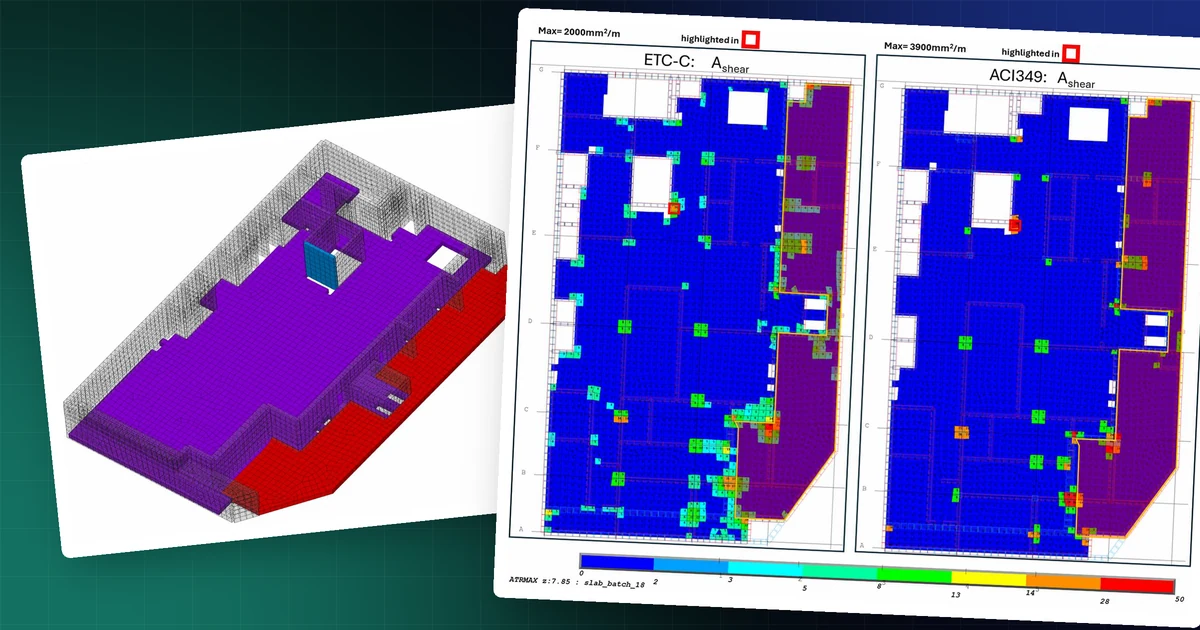
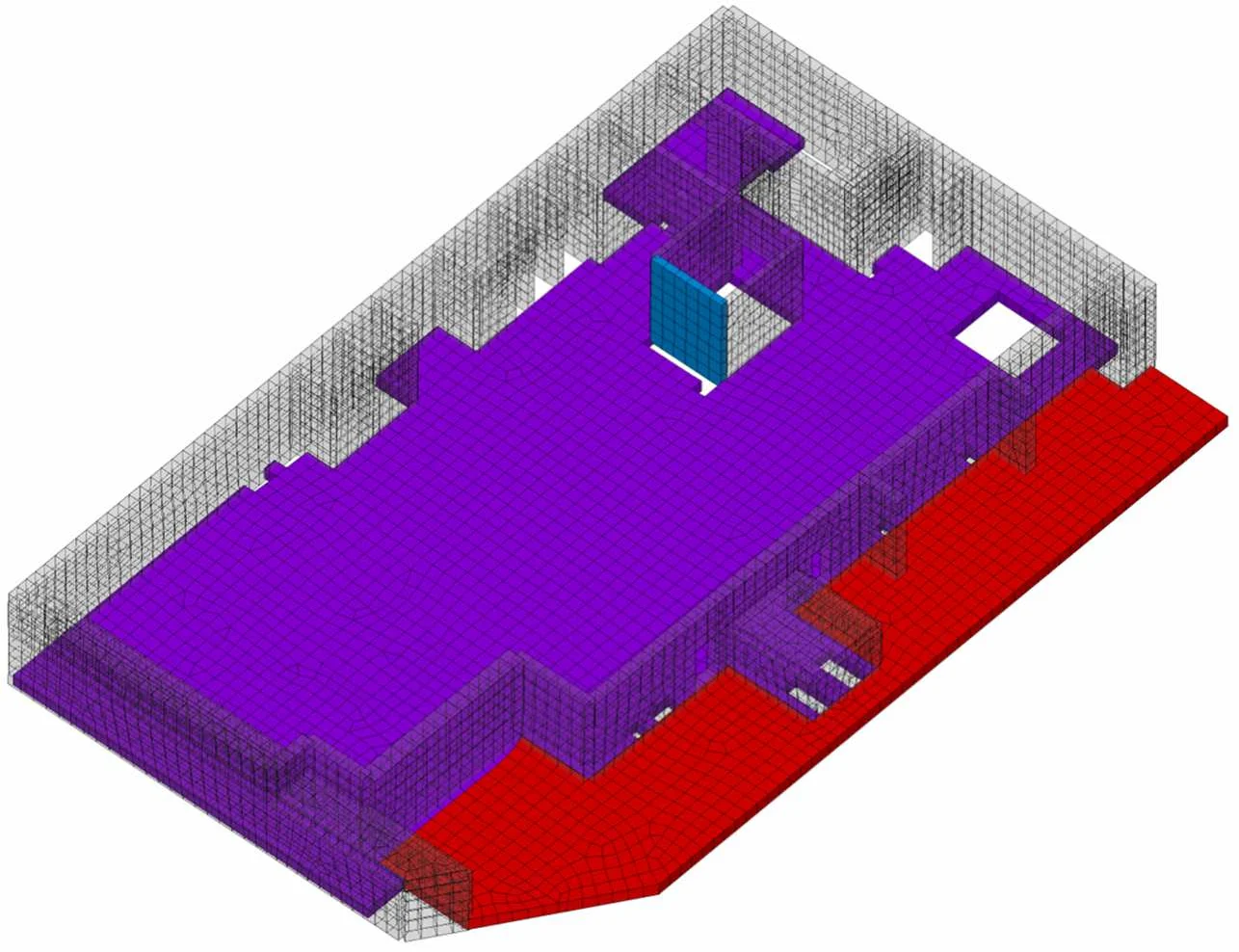
The authors took one nuclear island building from the Hinkley Point C EPR project: the HW Access Tower, a reinforced concrete structure about 37 m long, 23 m wide and 40 m tall. From its existing finite element model they took a representative internal floor slab (0.50 m thick) and one of the primary internal shear walls (0.30 m thick) at level 06, both in C40/50 concrete.
The forces and moments from that single analysis were post-processed with automated design software to both codes, so geometry, boundary conditions and action effects were identical and only the code changed. The ACI 349 designs in the study were produced with Shell Element Designer. The comparison covered ultimate limit state flexure and shear for two design conditions: a static condition for normal operation and climate loads (ULSf), and a dynamic condition for the design basis earthquake (ULSa). ETC-C was used in its 2010 edition, still the code applied on Hinkley Point C and Sizewell C; ACI 349 in its 2023 edition.
Where the codes differ
- Load factors. For the static condition, ETC-C uses 1.35 on dead and 1.50 on live load; ACI 349 uses 1.40 on dead load alone, or 1.20 dead plus 1.00 live plus 1.60 wind. Seismic combinations are close: 1.0 on dead and earthquake in both, with 0.30 of live load in ETC-C against 0.80 in ACI 349.
- Safety format. ETC-C reduces material strengths with partial factors (1.50 on concrete and 1.15 on steel for persistent situations, 1.20 and 1.00 for accidental ones). ACI 349 reduces the calculated capacity instead, with strength reduction factors such as 0.90 for tension-controlled sections and 0.75 for shear.
- Shear. ETC-C uses a variable strut inclination, with the concrete contribution linked to the longitudinal tensile reinforcement ratio. ACI 349 follows the ACI 318 approach with a roughly 45° truss for the links.
- Steel. ACI 349 does not allow Grade 75 or 80 bars to resist shear or torsion, capping the effective yield strength for shear at about 414 MPa.
The results
Peak required reinforcement from the paper, in mm²/m:
| Element | Check | Condition | ETC-C | ACI 349 |
|---|---|---|---|---|
| Slab, 0.50 m | Flexure | Static (ULSf) | 1,700 | 1,000 |
| Seismic (ULSa) | 2,500 | 2,100 | ||
| Shear | Static (ULSf) | 1,500 | 900 | |
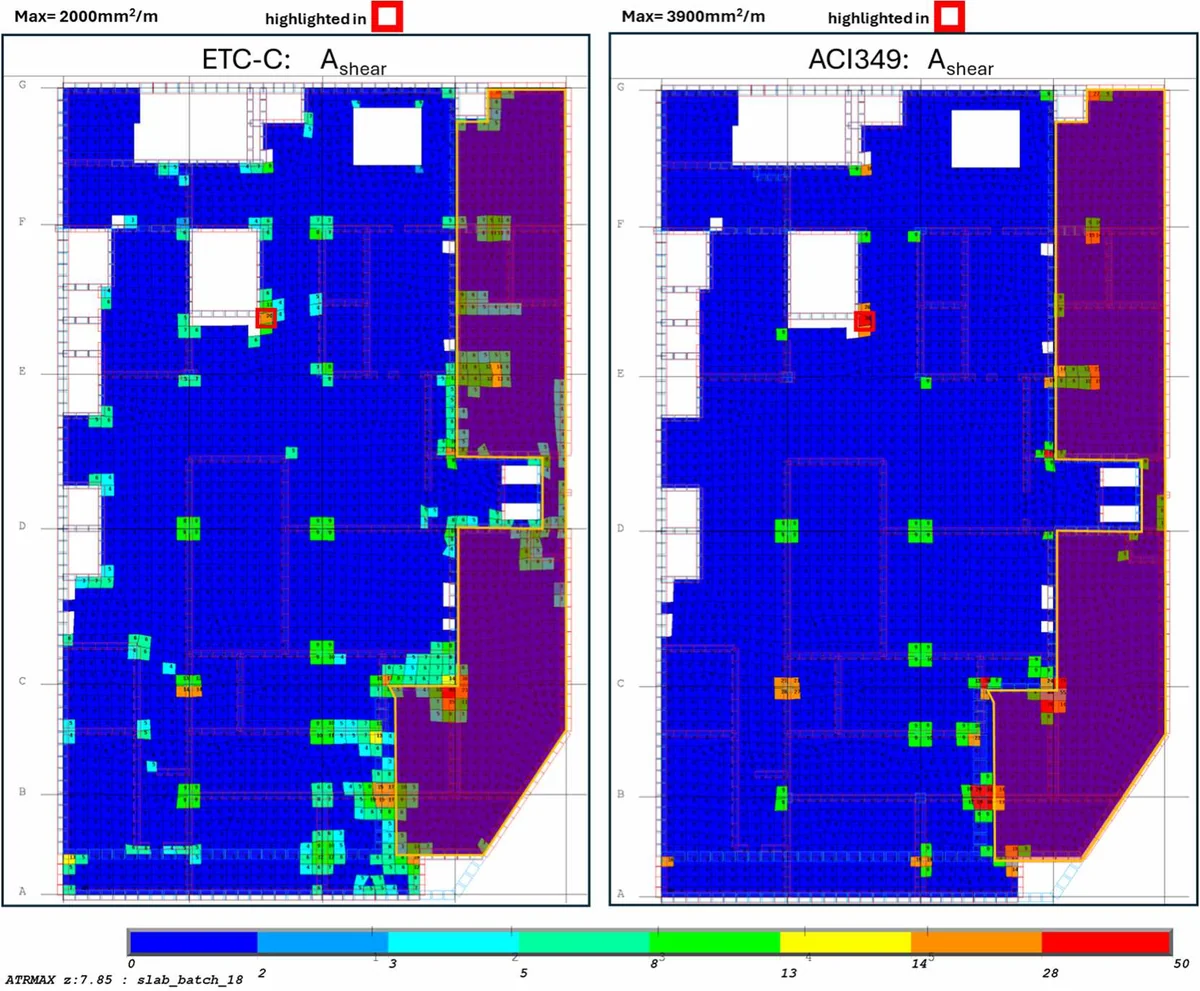
| Seismic (ULSa) | 2,000 | 3,900 | ||
| Wall, 0.30 m | Flexure | Static (ULSf) | 200 | 100 |
| Seismic (ULSa) | 1,400 | 1,800 | ||
| Shear | Static (ULSf) | 0 | 0 | |
| Seismic (ULSa) | 50 | 0 |
The higher requirement in each row is in bold.
For the slab, ETC-C governed flexure in both conditions, but under the seismic condition ACI 349 needed almost twice the shear reinforcement. For the wall the pattern reversed: ACI 349 governed flexure under seismic loading, while ETC-C required a small amount of shear reinforcement (50 mm²/m) where ACI 349 allowed the concrete alone to carry the shear.
What it found
The paper concludes that neither code is more conservative across the board. Each shows targeted conservatism depending on whether flexure or shear governs and on the type of element, and for the slab and wall studied the overall reinforcement was broadly comparable. The authors are careful to note that this covers a small number of elements; deep beams, heavily coupled walls or elements governed by anchorage, confinement or seismic detailing could show larger differences.
The detailing rules differ more visibly. ETC-C requires B500C steel with at least 7.5% elongation, minimum shear links in all walls and slabs, anchorage lengths increased by 50% and laps by 25% in columns, walls and foundation starter bars, and tying steel of 0.5% of the common section at every junction. ACI 349 limits the steel grades allowed for some uses, requires confinement only where compressive strain exceeds 0.002, and has no separate tying requirement.
Why an element-by-element comparison matters
Studies like this used to be impractical because they mean designing the same structure twice, element by element, for every load case. With automated design from a common analysis, it becomes a matter of running the same model to a second code. Shell Element Designer produced the ACI 349 designs for this study, and it also designs to AFCEN RCC-CW, the updated successor to ETC-C, so the same comparison can now be run against the current French code, alongside Eurocode 2.
Reference: H. Phan, M. Fry, J. Hadfield, H. Zhang, D. Freeke, I. Matboui, N. E. Guermoudj, V. N. Nguyen, S. Erlicher, O. Haboush and T. Blanchard, ‘Comparative study of reinforced concrete design for nuclear safety-related structures using ETC-C & ACI 349: case study for HPC EPR nuclear island building’, TINCE’26, poster N°197, Tours, 20 May 2026. Listed in the official conference programme (page 17). The paper will be linked here once SFEN publishes the proceedings.